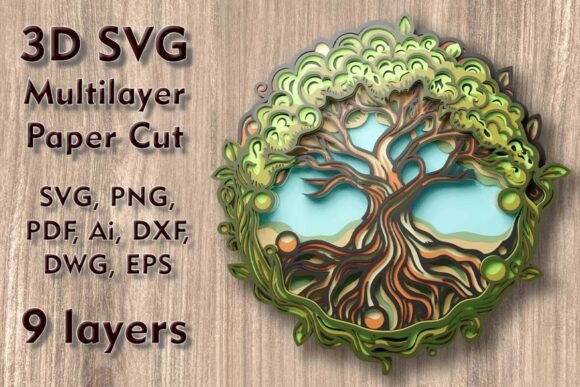
Reviewing the Tree of Life Multilayer PaperCut Files
As a designer who spends half my life digitizing and the other half stitching, I have learned to look past the glossy preview images. We all know that what looks crisp on a screen can sometimes turn into a tangled mess of thread on fabric. When I first encountered the Tree of Life Multilayer PaperСut Files, my initial reaction was cautious curiosity. The title suggests a medium—paper cutting—that is fundamentally different from embroidery. Paper relies on negative space and sharp, clean edges, while embroidery relies on texture, density, and the interplay of thread.
The product description highlights that these are 3D SVG Multilayer PaperСut Files for 3D Wall Art and Shadow Box with a substantial size of 9.85 H x 9.77 W in (250 x 248 mm). For an embroidery professional, this presents an immediate challenge and an opportunity. The note that "the size is easily increased, but be careful in reducing the design" is critical advice that applies doubly to needlework. If you are considering using this asset for a machine embroidery design, you must understand that scaling down intricate paper-cut layers can lead to stitch breaks and poor coverage if not handled with extreme care.
First Impressions: Mood and Visual Personality
The Tree of Life is a timeless motif, symbolizing growth, connection, and resilience. In this specific iteration, the multilayer approach creates a sense of depth that is rare in flat digital files. The mood is organic yet structured, balancing the wild nature of branches with the geometric precision of layered cuts. For a crafter or Etsy seller, this visual personality screams "high-end handmade." It does not look like a clip-art afterthought; it looks like a deliberate artistic choice.
However, translating this from a 3D SVG intended for shadow boxes to a stitched embroidery project requires translation. In paper crafting, layers sit physically apart. In embroidery, we simulate this through color changes, stitch types, and underlay. The design’s complexity means it is not suitable for a quick five-minute hoop. It demands attention. I imagine this working beautifully as a central focal point on a neutral canvas, where the intricacy can be appreciated without competing with busy fabric patterns.
Real-World Application: From Digital File to Finished Product
Let us consider a real-life scenario. Imagine you run a small boutique shop specializing in personalized gifts. A client requests a custom tote bag design for a literary club. They want something symbolic but elegant. Using the Tree of Life Multilayer PaperСut Files as a reference for your digitizing process, you could create a stunning piece. The large original size allows you to maintain detail even when adapting it for a standard 5x7 or 6x10 hoop.
For sweatshirt embroidery, this design would shine on the back of a high-quality cotton blend. The organic lines of the tree complement the soft texture of the fleece. However, you must consider the stitch density. Paper-cut designs often have thin, delicate lines. If you attempt to stitch these with a standard fill stitch at a small scale, the fabric may pucker. Instead, consider using a combination of satin stitch for the thicker trunk elements and a fine running stitch or beam stitch for the delicate outer branches. This approach preserves the "cut" aesthetic while ensuring the threads lay flat.
Another viable application is holiday embroidery or wedding gifts. A pillow cover featuring this tree, stitched in monochromatic tones like cream on white or gold on navy, exudes sophistication. It transforms a simple home good into a heirloom-quality handmade product. For commercial embroidery projects, such as branding for a wellness center or yoga studio, the tree symbol aligns perfectly with values of grounding and growth. Here, the design acts as a logo variant, requiring precise scaling and clean finish.
Navigating Technical Challenges
While the aesthetic potential is high, the technical execution requires vigilance. The warning about reducing the design size is paramount. If you shrink this digital embroidery file too much, the thin elements of the multilayer design will vanish or become un-stitchable. Always test on scrap fabric first. I recommend starting with a larger hoop size to preserve the integrity of the details.
Fabric choice is equally critical. On textured fabrics like linen or canvas, the intricate lines may get lost. On stretchy fabrics like jersey for baby embroidery or caps, the density of the design could cause distortion. You must use a robust stabilizer—likely a cut-away for garments that will be washed frequently. For embroidered patch creation, this design would require a stiff backing to maintain the shape of the delicate branches.
Dark fabrics present another hurdle. If you are stitching a light-colored tree on a black hoodie, you need high-contrast thread colors and potentially a lighter underlay to prevent the fabric from showing through the stitches. Always check your design in black and white mockups to ensure the contrast holds up without color reliance.
Value and Brand Consistency
Using a complex, well-thought-out design like the Tree of Life Multilayer PaperСut Files elevates your brand. It signals to customers that you care about detail. In the world of small shop products, differentiation is key. A generic tree design is common; a multilayered, depth-inspired interpretation stands out. This enhances customer trust and increases the perceived value of your finished product.
For design assets and printable mockup creation, this file offers versatility. Even if you are not stitching it immediately, having a high-quality SVG allows you to create compelling marketing materials. You can show potential clients how the design would look on various items, from aprons to tea towels, helping them visualize the final personalized gift.
Practical Designer Notes
- Test Before Committing: Always stitch a sample on the actual fabric you plan to use. Check for puckering and thread breaks.
- Check Licensing: Since this is originally a paper-cut file, confirm if the license covers commercial embroidery sales. Do not assume rights transfer across mediums.
- Adjust Density: If digitizing this yourself, reduce fill density for smaller sizes to prevent stiffness.
- Thread Selection: Use high-sheen rayon or polyester threads to mimic the smooth edge of a paper cut.
- Hoop Size: Ensure your hoop can accommodate the necessary size to keep details legible. Do not force a large design into a small hoop.
In conclusion, the Tree of Life Multilayer PaperСut Files is a potent resource for the creative entrepreneur. It bridges the gap between digital precision and tactile artistry. While it originates in the world of Shadow Boxes and paper crafts, its structural elegance translates well to embroidery when handled with expertise. By respecting the design’s complexity and adapting it thoughtfully to fabric and thread, you can create standout pieces that resonate with buyers and enhance your portfolio. Whether for a custom apparel line or a unique craft business offering, this design invites you to slow down, plan carefully, and stitch with intention.